


miND® Spike-Ins
miND® Spike-Ins

miND® Spike-In for small RNA-sequencing:

miND® spike-ins ensure your small RNA-seq data is publication-ready – with absolute normalization and validated quality control in a single reagent.

1. Quality control: confirm the dynamic range and quantitativeness of your small RNA sequencing experiments.

2. Absolute normalization: convert read counts to copies/µl total RNA and reduce bias originating from variation in RNA composition between samples.

miND® Spike-In design and usability:

miND® Spike-Ins are a proprietary oligonucleotide mix with unique design features (Lutzmayer et al.). They are added to your total RNA samples before microRNA or small RNA sequencing analysis. The spike-in sequence composition and concentration range have been optimized to be compatible with almost any species and a broad range of sample types, including biofluids (serum, plasma, urine, CSF, synovial fluid), cells, tissues, extracellular vesicles, and non-vesicular fractions (Khamina et al.).


miND® Spike-In
(96 Rxns)

€515/kit

miND spike in

miND® Spike-In

(96 Rxns)

€515/kit

miND spike in

benefits

The challenge: small RNA-sequencing, especially for challenging input samples such as biofluids, exosomes, or low cell numbers, is prone to sequencing bias. In addition, the comparison of microRNAs and other small RNAs between sample types with differing RNA compositions is skewed based on the assumption of a constant amount of small RNAs per sample (the underlying hypothesis for reads per million (RPM) normalization).

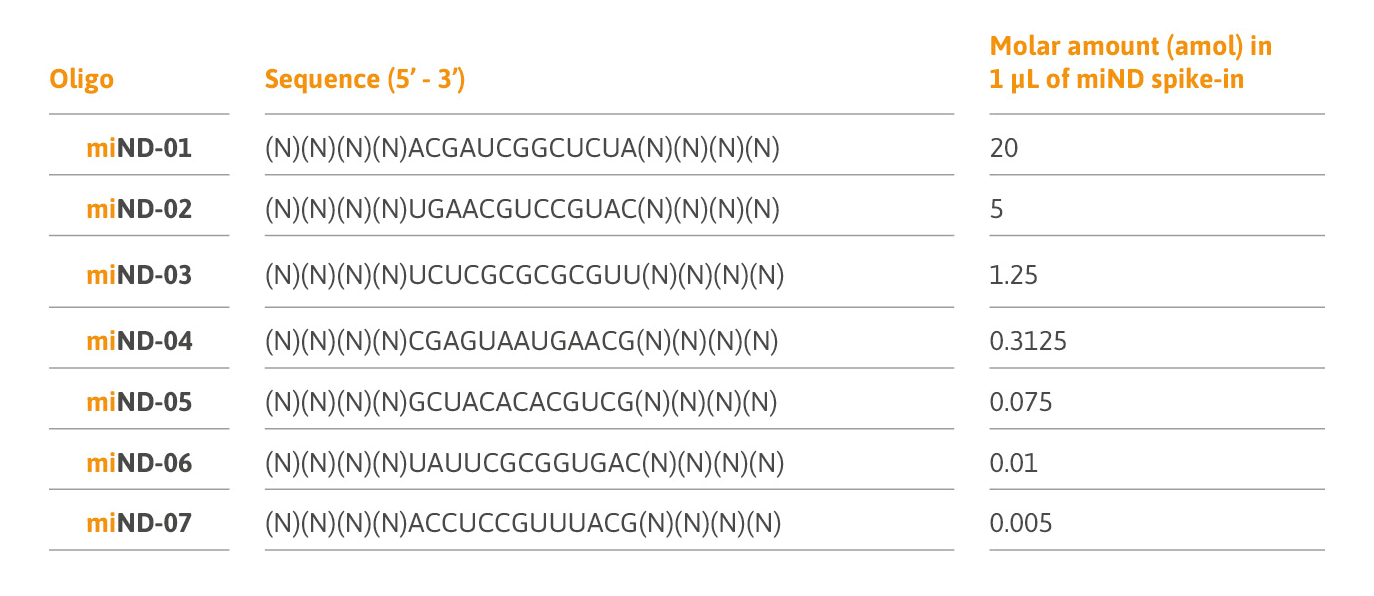
Our solution: miND® Spike-Ins are a novel quality control parameter and normalizer that consists of seven oligonucleotides, each characterized by a unique core sequence flanked by 4 randomized nucleotides. miND® Spike-Ins are provided in a specific ratio to cover the broad concentration range of endogenous small RNAs.

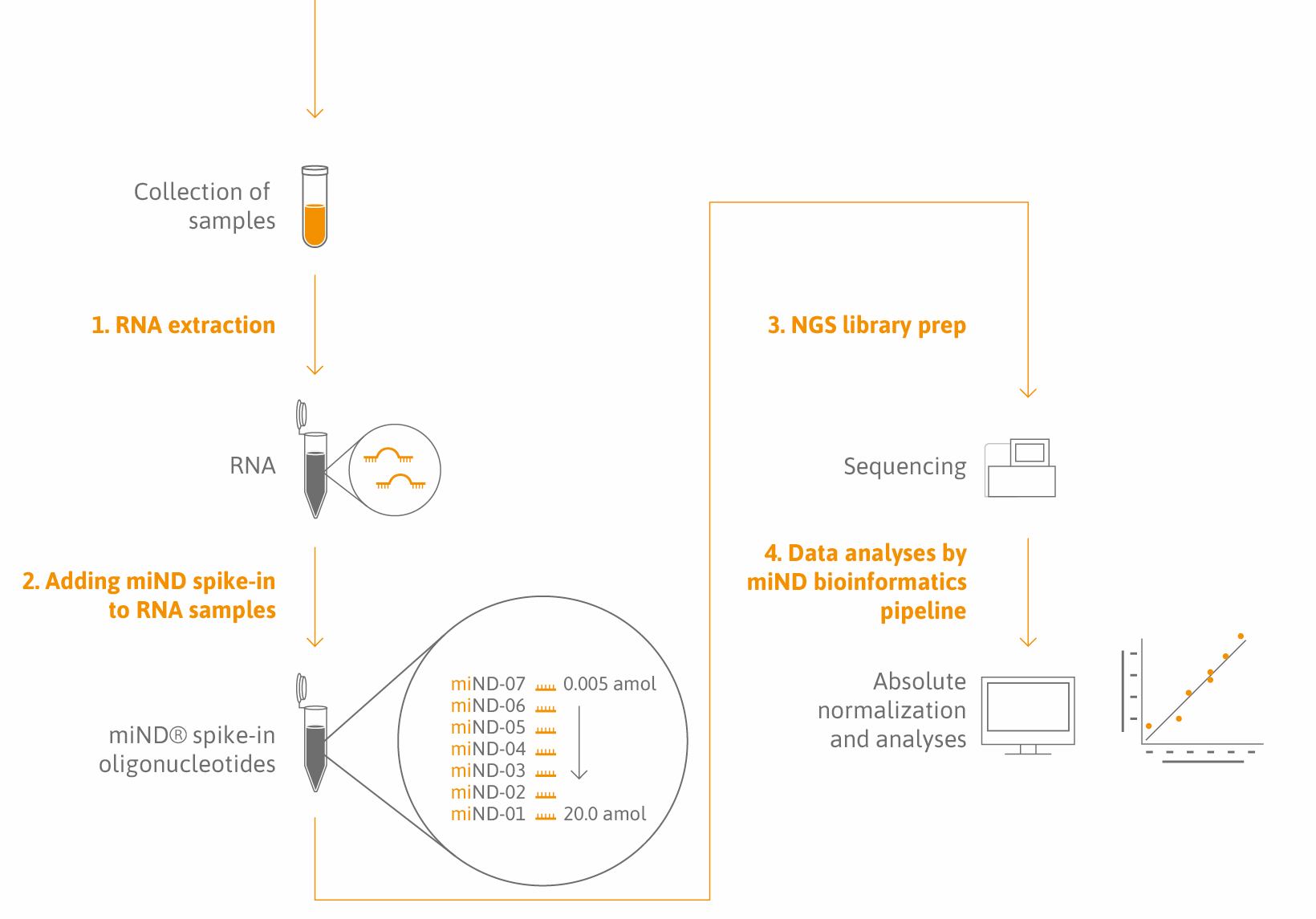
Simplicity: miND® Spike-Ins come as ready-to-use reagents. No dilution, mixing, or change in your workflow is required – miND® spike-ins are directly added to your RNA sample and used for NGS library preparation.

Broad compatibility: miND® spike-ins have been successfully tested for their compatibility with a broad range of small RNA library preparation kits including RealSeq, QIASeq, miRVEL, NEXTFLEX TM v4, and NEBNext® Low-Bias.

Sample-to-insight: our public data analysis pipeline was specifically developed to convert small RNA-sequencing raw data into a simple but comprehensive report providing full access to your data in the conventional way (RPM, read count) as well as in absolute concentrations. On top of that, we have added several unsupervised and supervised analyses and QC parameters to the report.

Not familiar with small RNA-sequencing?
No problem – the entire miND small RNA-seq workflow is provided as a service by TAmiRNA – request a quotation.
price list

  Product   Number Formulation Size Shipment Conditions Storage Price* Product Information Order
KT-041-MIND-96 lyophilized 96 reactions room temperature lyophilized: store at -20°C or -80°C after reconstitution: store at -80°C € 515 product sheet / manual request quote
KT-041-MIND-48 resuspended ready-to-use 48 reactions dry ice store at -80°C € 279 product sheet / manual request quote

* excluding shipment

frequently asked questions (FAQ)

Product overview

Spike-in controls for small RNA sequencing are synthetic RNA oligonucleotides of known sequence and concentration that are added to total RNA samples prior to library preparation. They provide a stable reference that is carried through every step of the sequencing workflow. As a result, spike-ins help monitor technical variability introduced during sample processing. Differences in spike-in recovery between samples can thereby reveal inconsistencies in library preparation, sequencing depth, or other technical biases.

When spike-ins are designed as ratiometric sequences they provide an additional advantage: they allow calibration of sequencing reads against known input amounts. This enables absolute or near-absolute normalization of miRNAs.

Standard small RNA sequencing data normalization methods, such as reads per million genome mapping reads (RPM), assume that the overall small RNA content is roughly constant between samples. In practice, this assumption is not always true, especially in:

  • Comparisons between sample types (e.g. plasma vs. cerebrospinal fluid), where RNA composition and total RNA abundance differ substantially
  • Method development and benchmarking, where spike-ins can be used to compare RNA extraction or library preparation protocols
  • Disease vs. healthy comparisons, where global shifts in miRNA or other small RNA expression may occur
  • Cross-batch or cross-laboratory comparisons, where differences in extraction or library preparation efficiency introduce technical variation

Relative normalization under these conditions can mask true biological signals. External spike-in controls bypass this problem because they are added at a known amount independently of the sample.

  • Relative normalization (e.g. RPM, TPM): Scales read counts within a sample relative to the total number of reads. This approach is fast and simple to compensate for varying sequencing depths but assumes that the overall small RNA composition is constant between samples. If one sample has a large overall increase or decrease in specific RNA classes, this scaling factor becomes distorted.
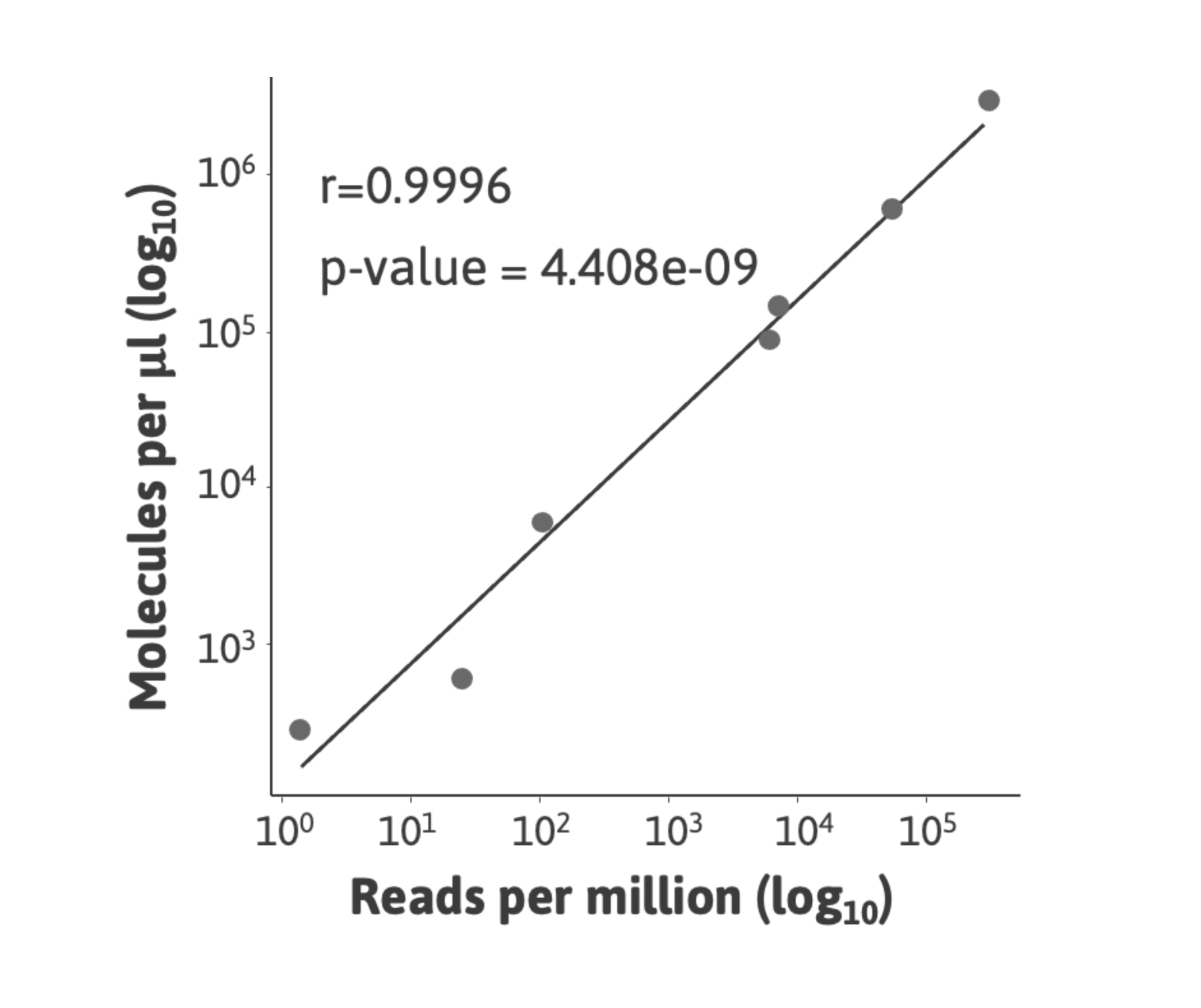
  • Absolute normalization with spike-ins: Uses external spike-ins of known concentration to generate a calibration curve that converts sequencing read counts into absolute abundance values, such as molecules/µl. Because normalization is anchored to an external standard, absolute normalization does not rely on assumptions about total small RNA content. This enables more accurate comparisons across biologically distinct sample types, disease states, sequencing batches and laboratories.

An ideal spike-in for small RNA sequencing should:

  • Match the size of endogenous targets: miRNAs are 20-22-nt long. Spike-ins must be in the size range of the target to be processed identically to endogenous miRNAs. General-purpose RNA spike-ins (e.g. ERCC, >250-nt) are not suitable.
  • Cover a wide dynamic range: Multiple spike-ins at different concentrations spanning 3-4 orders of magnitude are needed to capture the full abundance of endogenous miRNAs.
  • Have no homology to endogenous sequences: The spike-in sequences must be artificial to avoid cross-mapping to known miRNA or small RNAs.
  • Be resistant to ligation bias: Adapter ligation efficiency in small RNA-seq is highly sequence-dependent and is a known source of technical bias. Randomized flanking nucleotides at the 5’ and 3’ ends incorporated in the spike-in sequences reduce sequence specific adapter ligation artifacts that would distort calibration.
  • Exhibit high integrity and purity: HPLC purification removes truncated synthesis by-products that would inflate read counts.

The miND® spike-ins were designed with all of these criteria in mind. See the sections below for details.

The miND® spike-in controls are a panel of seven synthetic 21-nucleotide long RNA oligonucleotides designed to serve as external standards for small RNA sequencing experiments. They enable two key functions (1) quality control of library preparation workflows and (2) absolute quantification of miRNA NGS data by converting sequencing read counts into absolute copy numbers (molecules/µl).

Each spike-in consists of a unique 13-nucleotide core sequence flanked by 4 randomized nucleotides at each end. This unique design makes the spike-ins themselves less prone to biased detection across the calibration range. The seven spike-ins are supplied at defined molar ratios spanning approximately four orders of magnitude (0.005 to 20 amol/µl), covering the full dynamic range of endogenous circulating miRNAs.

Compatibility & Application

Yes. We have tested the compatibility and performance of the miND® spike-ins with several library preparation kits, including:

  • RealSeq®-Biofluids Small RNA Library Preparation Kit (RealSeq Biosciences)
  • QIAseq miRNA Library Kit (Qiagen)
  • NEXTFLEX Small RNA Sequencing Kit v4 (Revvity)
  • miRVEL Discovery Small RNA-Seq Library Prep (Lexogen)
  • NEBNext® Small RNA Library Prep (New England Biolabs)
  • NEBNext® Low-bias Small RNA Library Prep Kit (New England Biolabs)

This list reflects kits that feature different adapter ligation principles and that have been formally evaluated in combination with the miND® spike-in controls. Other small RNA library preparation protocols should also be compatible; however, performance validation data may not be available.

The spike-in concentration range has been selected to match the typical endogenous miRNA abundance in biofluid samples and have been extensively tested on:

  • Biofluids: serum, plasma, cerebrospinal fluid, synovial fluid, urine, and saliva
  • Extracellular vesicles and non-vesicular fractions extracted from biofluids and cell culture supernatant

For recommendations on how to use the spike-ins with cellular and tissue input, see sections below.

The spike-ins have been developed and optimized for use with biofluids and other low RNA input samples. The standard use is therefore for total RNA inputs ranging from 0.5 – 50 ng at which the addition of 1 µl spike-in is recommended. For use with inputs >50 ng total RNA the recommended spike-in volume scales with the total RNA input to ensure that the spike-in signals remain proportionate to the endogenous miRNA signal.

Total RNA input Recommended spike-in volume Typical sample types
Standard: 0.5 – 50 ng 1 µl Biofluids (serum, plasma, urine, synovial fluid), extracellular vesicles
50 – 100 ng 1 – 2 µl Cells, small tissue amounts
≥ 100 ng ≥ 2 µl Tissue, high-input cell experiments

Important: If you change the spike-in volume from the standard recommended 1 µl, you must update the corresponding volume in the absolute concentration calculations. See the next question for details.

Yes, this is critical if you intend to work with the spike-in normalized data. The absolute concentration calculation is based on the known input amount of each spike-in. When the volume added differs from the standard 1 µl, the actual amount of spike-in introduced into the reaction changes, and the calibration curve will be shifted accordingly.

Update the spike-in input volume parameter in your analysis to match the volume used. Failing to do so, will cause a proportional error in all calculated concentrations: e.g. using 2 µl without updating the calculation will cause concentrations to appear 2x lower than the true values.

If you are using the miND pipeline (TAmiRNA), the spike-in volume is a configurable input parameter in the markdown file.

Generally, no. The spike-ins are optimized for biofluid samples, which are inherently low-input matrices. The standard volume specified in the product´s IFU is designed for this range and should not require dilution for typical biofluid inputs and EVs.

The spike-ins are optimized for addition directly to the extracted RNA sample immediately before small RNA library preparation.

The spike-ins are optimized for addition directly to the extracted RNA sample prior to library preparation. While pre-isolation addition is possible, it requires additional consideration and is not the default recommendation.

As a rule of thumb, use the following approach to determine the appropriate spike-in volume:

  1. Identify the spike-in volume (Vspike-in (lib prep)) and RNA input volume (VRNA input) recommended in your library preparation protocol and sample type.
  2. Calculate the spike-in ratio: Divide the recommended spike-in volume by the RNA input volume.
  3. Multiply this ratio by your RNA elution volume (Velution).
  4. Apply a correction factor based on the estimated RNA extraction efficiency (E) of your workflow to obtain the pre-isolation spike-in volume (Vspike-in (pre-isolation)).

Example: The protocol recommends 1 µl spike-in added to 8.5 µl RNA input as starting material for library preparation. If RNA is eluted in 50 µl and extraction efficiency is estimated at 70%, the recommended pre-isolation volume would be (1/8.5) x 50 x (1/0.7) = 8.4 µl.

Important considerations:

  • Add the spike-ins to the lysis buffer or lysis master mix prior to sample addition. Do not add the spike-ins directly into the biological sample (e.g. plasma).

Note: Spike-ins added directly to a biological sample are exposed to the sample matrix before protective lysis conditions are established. This leads to degradation by RNases present in the sample.

  • If extraction efficiency is unknown, an estimate of 50-70% (E = 0.5-0.7) is a reasonable starting point.
  • Optimization and pilot testing are strongly recommended before applying pre-isolation spike-in addition to a full experiment, as recovery can vary between extraction kits, sample matrices and library preparation methods.
  • Absolute quantification is not recommended when spike-ins are added prior to RNA isolation as the fraction of spike-ins recovered is not precisely known.

Quality

Each new miND® spike-in LOT undergoes a two-stage quality control process before release:

  1. Concentration verification by RT-qPCR

The concentration of the highest-abundance spike-in is first verified by RT-qPCR. This step confirms that the lot was produced at the correct concentrations.

  1. NGS validation

Lots that pass the RT-qPCR step are validated by sequencing. Plasma RNA extracted with two different RNA extraction kits, each prepared in three technical replicates, is used to run the full workflow. During this NGS-QC step, the following parameters are confirmed:

  • Presence and detection of all 7 spike-ins
  • Correct abundance
  • Expected vs. observed concentrations via linear regression
  • Coverage of endogenous plasma miRNAs
  • Presence of the expected full-length 21-nt sequences (no truncations)

As the spike-ins are present at very low molar concentrations, slight variations between synthesis LOTs are inherent and expected. TAmiRNA produces LOTs in bulk to support comparability over multiple years.

To ensure comparability for larger-scale or long-term studies, we recommend purchasing sufficient stock from a single LOT to cover the entire study. The lyophilized miND® spike-in kit (KT-041-MIND-96) provides long-term stability, making it well suited for extended studies where consistent performance over time is critical.

The miND® spike-ins are HPLC purified to minimize the presence of truncated synthesis by-products. In addition, we performed a comprehensive assessment of spike-in sequence lengths across >5,000 samples. This analysis consistently demonstrates that the vast majority of aligned spike-in reads correspond to the expected full-length 21-nt sequences.

Data Analysis

The following questions cover the bioinformatics workflow for processing miND® spike-in data. They complement the wet-lab guidance above and address the most frequent questions we receive about the open-source scripts and Docker tools published at https://github.com/tamirna.

You do not have to run the full miND® pipeline. We provide three layers of tooling on our public GitHub (https://github.com/tamirna), and you can enter the workflow at whichever level fits your existing setup:

  • miND (full pipeline): Snakemake pipeline that runs the entire workflow from raw FASTQ to a final HTML report with QC, miRNA counts, spike-in calibration, and differential expression. Recommended when you do not already have a small RNA-seq pipeline in place. The publication describing the pipeline is Diendorfer et al., F1000Research 2022.
  • mind-spikein-docker (quantification only): a dockerized Snakemake workflow that takes trimmed, quality-filtered FASTQ files as input and produces miRNA counts (via miRDeep2) and spike-in counts (via bbduk). Use this if you already have your own adapter trimming and QC and just want consistent miRNA and spike-in quantification.
  • mind-spike-in-concentrations (calibration only): an R script (miND-spikein.R) that takes the miRNA and spike-in count files produced by the docker tool and fits the calibration model, calculates absolute concentrations in molecules/µL, and writes per-sample QC plots and a spikein_stats.csv summary. Use this if you already have count tables from your own aligner and want only the calibration step.

If you are integrating spike-in quantification into an existing pipeline, the simplest path is to add the spike-in FASTA as an additional reference in your alignment step and then run miND-spikein.R on the resulting counts.

The script reads two files per sample from input_data_path//:

  • .mirnas.csv: tab-separated table of miRNA read counts. The first column header must be #miRNA and the read-count column must be named read_count. This matches the output of miRDeep2 quantifier.pl. If a miRNA appears multiple times (e.g. mature and star), the script keeps the maximum count per ID.
  • .spikeins.txt: standard bbduk stats output produced by mapping reads against the spike-in FASTA. The script reads the library size from line 2 and the per-spike-in #Name/Reads table starting at line 4. Spike-in IDs must be of the form #miND-NN, where NN runs from 01 to 07 (the seven core sequences).

A SampleContrastSheet.xlsx is not the input to this script. The contrast sheet is the entry point for the full miND® pipeline; it is not consumed by the spike-in calibration script directly. Only the per-sample CSV and TXT count files are needed.

If you produce counts with a different aligner (e.g. STAR, bowtie, salmon), build the two files in the format above before running the script, or reuse the calibration logic in your own code (see the next question for the formula).

The script fits an ordinary least-squares linear regression of the known molar concentration of each spike-in on its observed read count, forced through the origin:

concentration_i = slope × read_count_i (intercept fixed at 0)

The slope and the model R-squared are derived from the seven calibrator points using R’s lm(concentration ~ 0 + rc, data = sample_spikeins). The known molar concentration of each spike-in in the final sample is calculated from its stock concentration as:

concentration_in_sample [molecules/µL] = stock_concentration [amol/µL] × spikein_volume [µL] × 6.02214e5 / final_volume [µL]

Defaults in the published script: spikein_volume = 1 µL and final_volume = 9.5 µL (1 µL spike-in plus 8.5 µL RNA input, matching the RealSeq-Biofluids working volume). Stock concentrations of the seven spike-ins miND-01 to miND-07 are 20, 5, 1.25, 0.3125, 0.075, 0.01 and 0.005 amol/µL respectively.

If you use a different spike-in volume or a different library prep with a different RNA input volume, update both parameters in the script. Otherwise all calculated concentrations will be off by the corresponding factor (e.g. using 2 µL spike-in without changing the parameter will make endogenous miRNAs look 2x less abundant than they actually are).

For every sample the script writes one row to spikein_stats.csv and a _spikein_qc.pdf plot. The fields are:

  • spikeins_detected: number of the seven core sequences with at least one read.
  • intercept, slope, rsq: parameters of the calibration line. Intercept is fixed at zero by design.
  • spikein_lower_limit, spikein_upper_limit: lowest and highest spike-in read counts in this sample. miRNAs with counts inside this range are quantified by interpolation; outside the range they are extrapolated and the range column in the per-sample concentrations file is marked too low or too high.
  • mirnas_in_range: number of detected miRNAs that fall inside the calibrator range. The QC PDF reports the percentage of miRNAs in range.
  • qc: free-text combination of: OK; warning (not all spikeins detected) when 5 or 6 of 7 are detected and calibration still runs; warning (less than 50% of miRNAs in spikeins range) when the dynamic range of the library is not well covered; FAILED (R squared less than 0.95) when the calibration line does not fit the calibrators and absolute concentrations should not be used; FAILED (2 or more spike ins missing) when the model cannot be fitted at all.

Use absolute concentrations only for samples flagged OK or warning. Samples flagged FAILED should be excluded from spike-in normalized analyses; you may still use their relative miRNA counts.

Spike-in reads must be excluded from the count matrix that goes into the DEA tool (edgeR, DESeq2, limma-voom). They are calibrators, not biological features, and leaving them in will inflate library sizes and distort dispersion estimates. Drop all rows where the feature ID starts with #miND- before constructing the DGEList or DESeqDataSet.

There are two common ways to use the spike-in information in a DEA:

  • Spike-ins as size factors / offsets: compute a per-sample scaling factor from the calibration slope (samples where one read corresponds to fewer molecules/µL have higher library efficiency and need to be scaled down accordingly) and pass it to DGEList$samples$norm.factors (edgeR) or sizeFactors() (DESeq2) in place of the default TMM or median-of-ratios factors. This is the most direct way to remove global composition bias between groups.
  • Filter to miRNAs in calibrator range, then DEA on absolute concentrations: use the range == “in range” column from each sample’s _concentrations.csv to keep only miRNAs with reliable absolute values, then run your statistical test on the calibrated molecules/µL values rather than on raw counts.

The full miND® pipeline performs the spike-in filtering automatically in its built-in DEA step.

Troubleshooting

If you do not detect all seven spike-in sequences work through the following checklist:

  • Sequencing depth: A minimum of 7.5 million reads per sample is recommended for reliable detection of all seven spike-ins. Very shallow sequencing will cause the lowest-abundance spike-ins to fall below the detection threshold.
  • Reconstitution: Confirm that the correct spike-in reconstitution volume has been used as outlined in the latest version of the manual and that the spike-ins are mixed thoroughly before use.
  • Spike-in addition step: Confirm that the spike-ins were added to the RNA right before library preparation.
  • Spike-in volume: Verify that an appropriate spike-in volume has been used. For high input/complexity samples, the spike-in volume may be increased. See the recommendations above.
  • Library QC: Check if the library QC (TapeStation/Fragment Analyzer) profile looks like expected.
  • miRNA mappings: Check if the miRNA mappings look as expected. A low recovery of low abundance miRNAs may indicate insufficient sequencing depth.
  • Freeze-thaw cycles: Repeated freeze-thaw cycles can degrade the spike-in oligos. Aliquot the working stock to minimize freeze-thaw cycles and store resuspended aliquots at -80°C.
  • Clean workspace: To minimize the potential of degradation of the spike-ins, make sure that you clean your workspace with an appropriate RNase decontamination solution before starting.

If the issue persists, contact support@tamirna.com with your sequencing QC data and sample processing information for further assistance.

When spike-ins were confirmed to have been added and the library preparation QC (e.g. TapeStation/Fragment Analyzer profiles) looks as expected, the typical causes are:

  • Bioinformatics: Ensure that the spike-in sequences are included in the reference set used for read alignment. The miND pipeline (TAmiRNA) includes spike-in sequences by default, for other pipelines, add the spike-in FASTA sequences for mapping.
  • RNA input amounts >100 ng: The spike-ins have been validated for total RNA input amounts up to 100 ng. Using higher RNA inputs may reduce or completely obscure spike-in representation relative to endogenous small RNAs, potentially resulting in very low or undetectable spike-in counts.

This depends on how many spike-ins are detected and which ones are missing:

  • ≥ 5 spike-ins detected: Normalization is supported, the calibration curve remains robust.
  • ≤ 4 spike-ins detected: Normalization is not recommended. This typically indicates a technical issue. Investigate the root cause before interpreting results.

Note: If only the lowest-concentration spike-ins (e.g. miND-06, miND-07) are missing, this may simply reflect the assay’s detection limit rather than a failed experiment. In that situation, review the total sequencing depth and overall library complexity.

If the spike-in reads represent an unusually high proportion of your total mapped reads, this may be a signal that the endogenous RNA input was lower than expected or that an excessive amount of spike-ins was added to the sample.

  • Review the RNA isolation protocol: Losses during RNA extraction (e.g. inefficient elution, wrong protocol for the sample type) can dramatically reduce endogenous RNA recovery.
  • Spike-in reconstitution volume: Verify that the spike-ins were reconstituted using the correct volume specified in the latest version of the IFU.

High between sample variability in spike-in countstypically points to pipetting imprecision as the primary cause.

To improve reproducibility, check the following:

  • Use a calibrated pipette: Verify that the pipette used for spike-in addition is properly calibrated and performs accurately in the 1 µl range. For very small volumes (≤1 µl), reverse pipetting can improve precision and consistency.
  • Mix thoroughly before use: Ensure that the spike-in working stock is properly resuspended, completely thawed, and mixed thoroughly before addition to samples.
  • Prepare a master mix when possible: Some library preparation workflows allow spike-ins to be added directly to an adapter ligation or reaction master mix. This reduces replicate-to-replicate variability introduced by repeated individual pipetting steps.
miND spike in
small RNA sequencing service
miND spike in