
Reproducibility is one of the biggest challenges in small RNA sequencing – and at the same time one of the most critical requirements for valid biomarker studies. Whether you are comparing data across batches, running multi-laboratory studies, or working with disease cohorts that show shifts in global RNA content: without an external reference, there is no reliable anchor to make your data truly comparable.
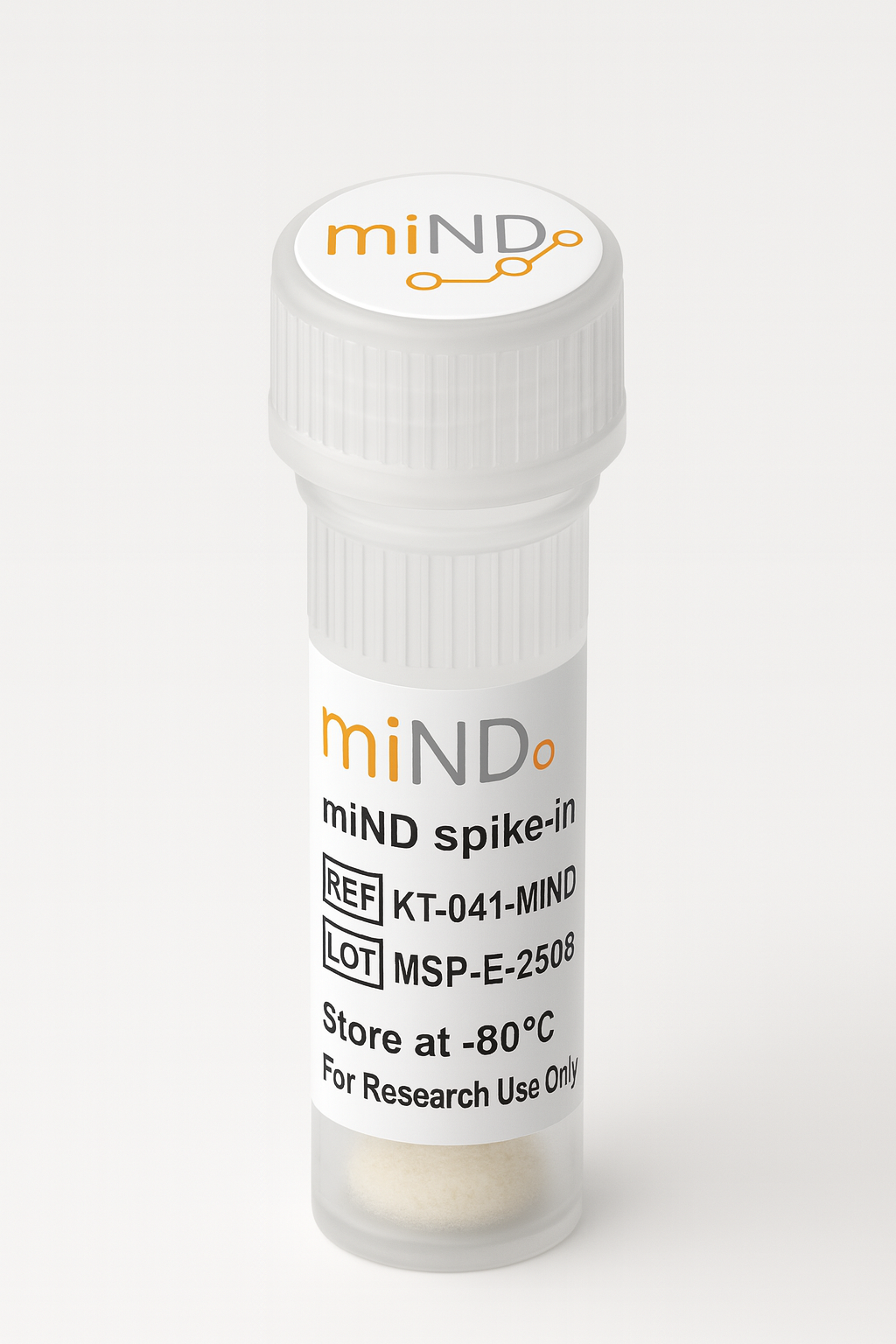
This is exactly where TAmiRNA’s miND® Spike-ins come in. In our new miND® Spike-ins FAQ Guide, we answer the three most frequently asked questions we receive from researchers and CRO partners.
How are spike-ins used?
miND® Spike-ins are added directly to extracted RNA immediately before library preparation. This means they travel through the entire downstream workflow – from adapter ligation and amplification through to sequencing. As an external reference, they allow technical variance to be tracked across every step and provide the foundation for absolute quantification of your RNA targets.
Which controls should I select?
Not all spike-ins are created equal. For reliable controls in small RNA-seq experiments, you need sequences that are:
- size-matched to your target RNA (e.g. ~22 nt for miRNAs),
- free of homology to the host genome,
- designed with randomized flanking ends to neutralize sequence-dependent adapter ligation bias.
miND® Spike-ins were developed specifically according to these criteria to minimize artificial distortions in sequencing results.
How do spike-ins improve reproducibility?
Relative normalization methods such as RPM or TPM break down when global RNA content shifts between sample types or disease states – a common problem in biomarker studies. Spike-ins act as an independent anchor that bypasses composition bias and makes your data comparable across batches and laboratories.
Ready for the full picture?
The complete FAQ Guide includes:
- Exact formulas for normalization and absolute quantification
- Kit compatibility matrices for common small RNA-seq library preparation kits
- Open-source R code for miND® Spike-in data analysis
Questions about miND® Spike-ins or wondering whether they are the right fit for your project? Get in touch – we are happy to help.