
17 11, 2026

CEO and CSO Matthias Hackl is heading to ISEVxTech2026 in Sacramento

2026-11-17T12:07:55+01:00November 17th, 2026|extracellular vesicle, RNA, small RNA-sequencing, smallRNA|0 Comments

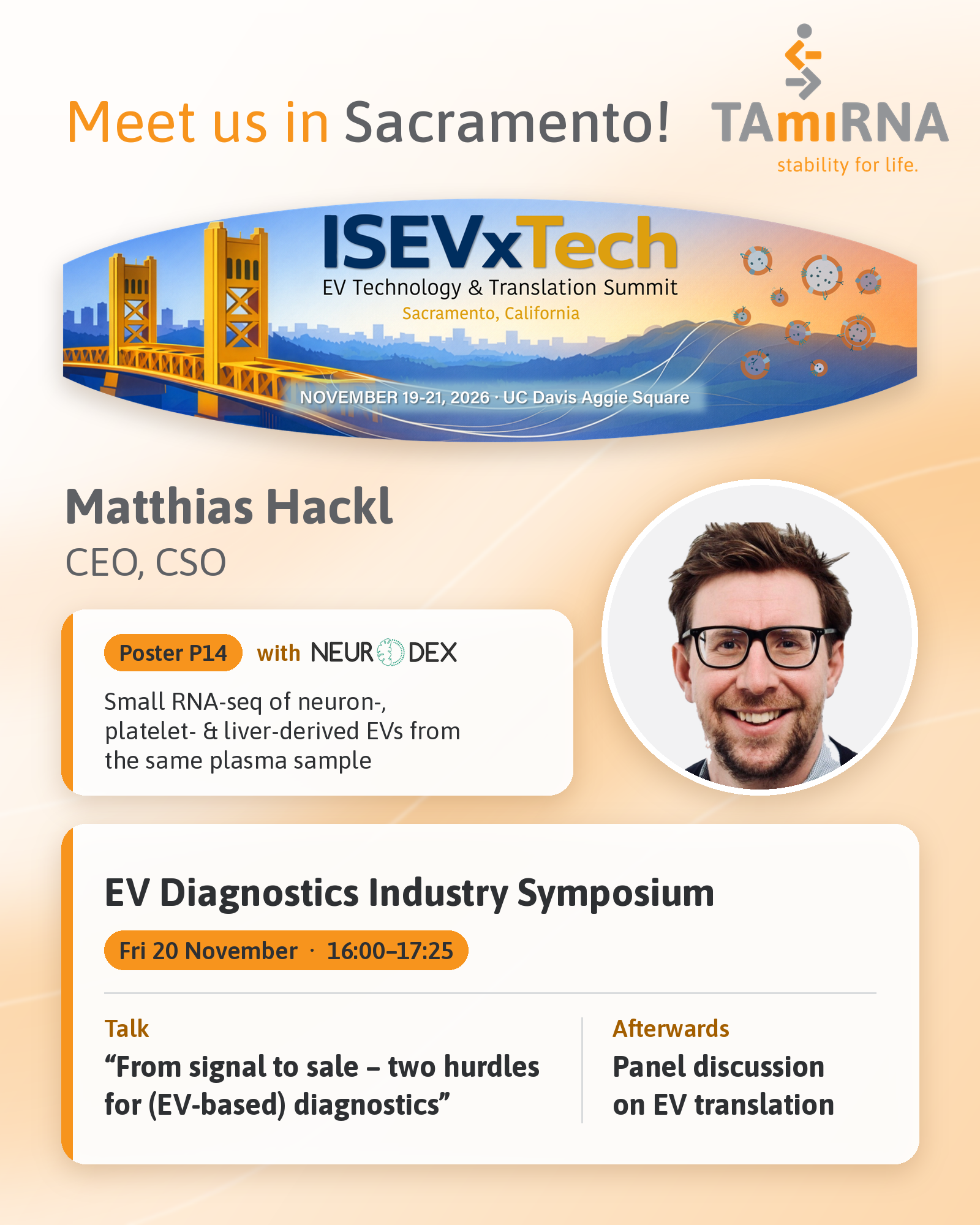
This week our CEO and CSO Matthias Hackl will attend the ISEVxTech2026 (19–21 November, UC Davis Aggie Square), with a talk, a panel and a poster. Friday, 20 November, 16:00–17:25, EV Diagnostics Industry Symposium, organised with the ISEV Translation, Regulation and Advocacy Committee. In five minutes, "From signal to sale – two hurdles for (EV-based) diagnostics": The technical hurdle is signal-to-noise. We can't change biology, but we can choose where to look: multi-omics in discovery, enrichment of EV subpopulations, ML to combine markers. And we can cut noise with tight pre-analytical and analytical control. The commercial hurdle: approved is not adopted. A test is used when someone pays for it, and willingness to pay has to be [...]

2 11, 2026

Advances in Influenza Vaccine Production

2026-11-02T11:33:45+01:00November 2nd, 2026|Influenza, RNA, small RNA-sequencing, smallRNA, Transcriptomics, VaccineDevelopment|Comments Off on Advances in Influenza Vaccine Production

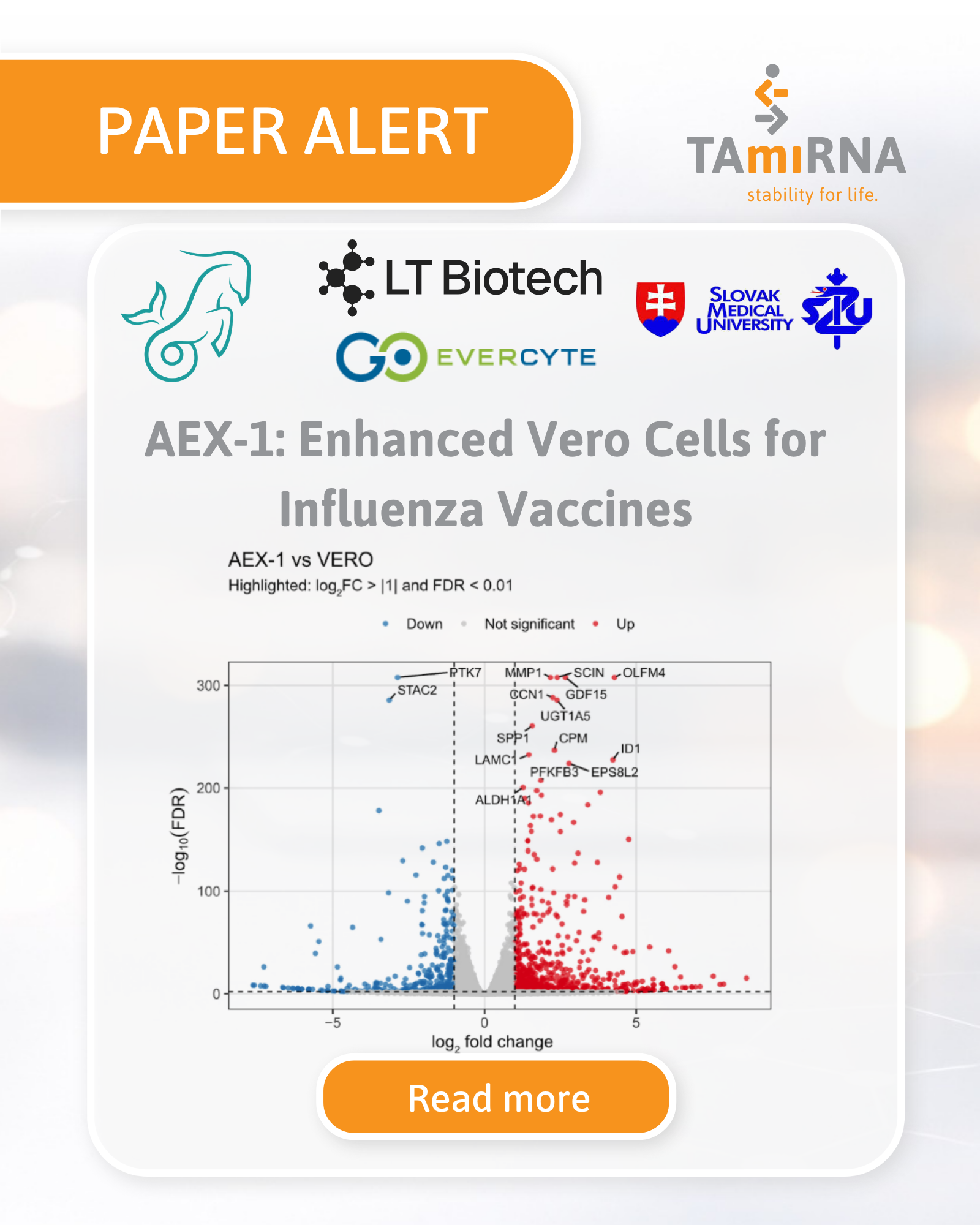
Influenza viruses require an acidic endosomal environment to uncoat and replicate efficiently. Standard Vero cells struggle with sufficient acidification, creating a yield bottleneck in cell-culture-based vaccine manufacturing. In a new publication in Vaccine, our collaborators at Capricorn Technologies, alongside Evercyte, LT Biotech, and the Slovak Medical University, present AEX-1: a novel Vero cell variant engineered to overcome this exact bottleneck. 💡 Key Findings: Enhanced Endosomal Acidification: AEX-1 features a measurably more acidic endosomal-lysosomal compartment, a phenotype that remains stable across 50+ population doublings. Dramatic Yield Improvements: At the 72-hour harvest point, AEX-1 achieved H1N1 and Influenza B vaccine virus titers 0.9–1.7 log₁₀ higher than parental Vero cells—approaching traditional egg yields. Higher Yields for Clinical Isolates: For a [...]

22 10, 2026

Our microRNA toolbox has a new look

2026-10-22T11:40:00+02:00October 22nd, 2026|biomarker, diagnostics, NGS, sequencing, small RNA-sequencing, smallRNA|Comments Off on Our microRNA toolbox has a new look

Anyone working with microRNAs knows the problem: there are a lot of databases and analysis tools, and it isn’t always obvious which one fits your research question. Plus, every year new tools are released that facilitate the functional analysis of microRNAs. That’s why we reworked our overview of web-based microRNA tools. It is now live with a new design. The biggest change is the structure. Instead of a simple list, the tools are now grouped by common research questions. These cover target prediction, experimentally validated miRNA-mRNA target interactions, pathway analysis, sequence and nomenclature, tissue expression, disease associations, small RNA-seq data analysis and data visualisation. This takes you straight from your question to the right tool. The page [...]

22 09, 2026

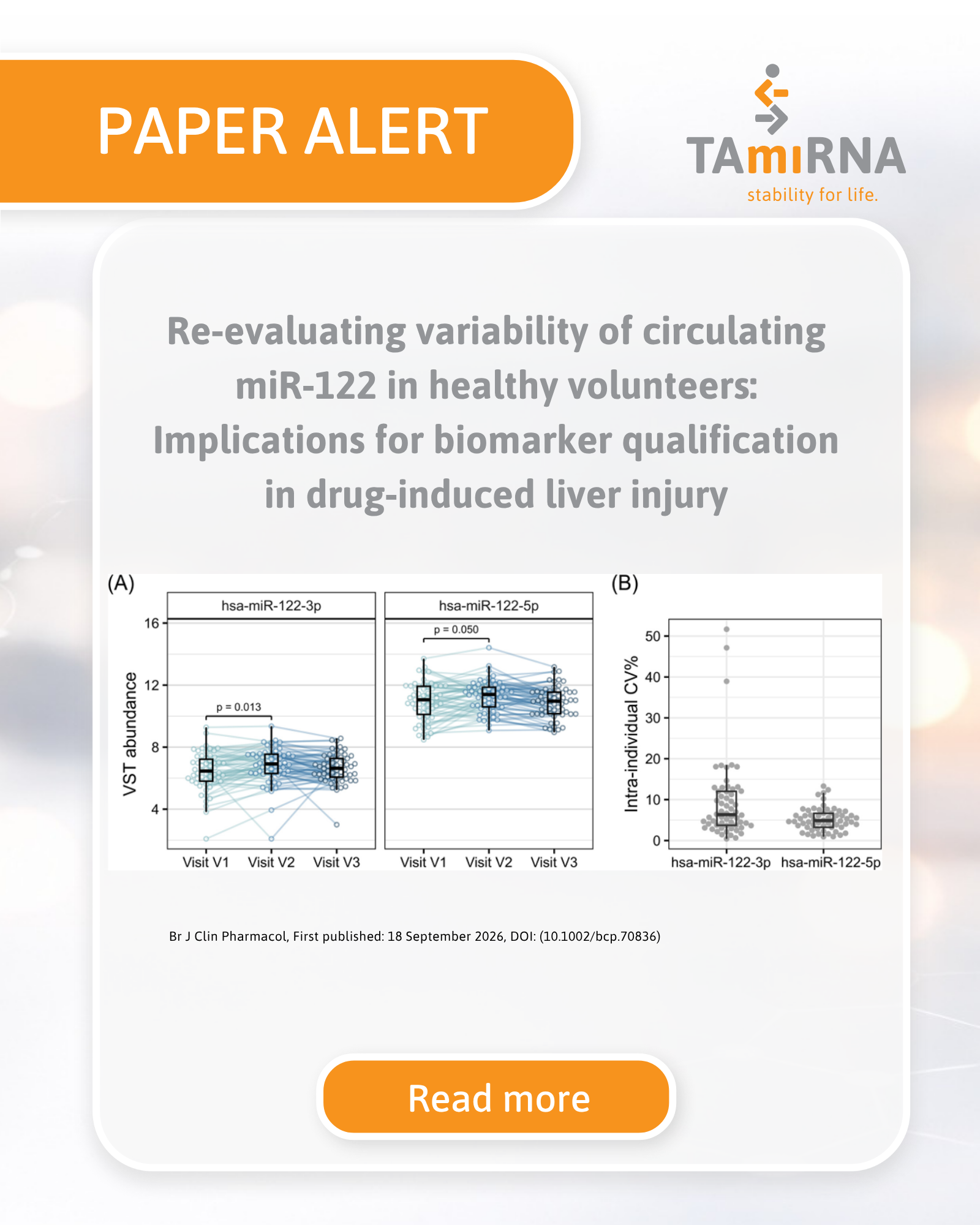
New evidence on variability of plasma miR-122 published with contribution of TAmiRNA

2026-09-22T10:58:24+02:00September 22nd, 2026|biomarker, circulating miRNAs, DILI, drug-induced liver injury, microRNA services, miND, miND spike ins, RNA, small RNA-sequencing, smallRNA, TransBioLine|Comments Off on New evidence on variability of plasma miR-122 published with contribution of TAmiRNA

A short communication published in the British Journal of Clinical Pharmacology re-evaluates the inter- and intra-individual variability of circulating miR-122 in healthy volunteers, using small RNA sequencing generated on TAmiRNA's miND workflow (Javid et al., 2026, doi:10.1002/bcp.70836). Background MicroRNA-122 (miR-122) is a liver-enriched circulating microRNA and one of the most extensively studied candidate biomarkers for drug-induced liver injury (DILI). A 2019 evaluation by Church et al. reported substantial inter- and intra-individual variability of miR-122 in healthy volunteers, which raised questions about its use as a diagnostic biomarker. The present study, conducted within the IMI2 TransBioLine consortium, set out to re-examine this variability in new, independent cohorts. Study and findings Plasma samples from 280 healthy volunteers were collected [...]

8 09, 2026

TAmiRNA Joins Six European RNA Specialists to Launch the European RNA Alliance

2026-09-10T10:01:04+02:00September 8th, 2026|biomarker, circulating miRNAs, ERA, European RNA Alliance, EV characterization, exosomes, extracellular vesicle, microRNA services, miND, miND spike ins, RNA, small RNA-sequencing, smallRNA|1 Comment

As a founding member of ERA, TAmiRNA positions itself as the innovative driving force behind RNA biomarker development in Europe — combining novel biomarker products with premier research services in cell-free RNA and EV/exosome analysis. Vienna, Austria — September 8, 2026 TAmiRNA is proud to announce that it has joined six other independent European RNA companies — Anemocyte, Genevia Technologies, Immagina Biotechnology, Lexogen, MultiplexDX, and siTOOLS Biotech — as a founding member of the European RNA Alliance (ERA), a new strategic alliance launched today to strengthen Europe's position in high-quality RNA technologies. RNA technologies are increasingly central to modern medicine — diagnostics, disease monitoring, prophylaxis, therapeutics, and personalized treatment. Yet Europe's considerable expertise in this space is [...]

1 09, 2026

TAmiRNA is a Silver Sponsor at the D-A-CH EV Meeting 2026 in Erlangen

2026-09-01T10:20:37+02:00September 1st, 2026|biomarker, circulating miRNAs, Conference, EV characterization, exosomes, extracellular vesicle, microRNA services, miND, miND spike ins, RNA, small RNA-sequencing, smallRNA|Comments Off on TAmiRNA is a Silver Sponsor at the D-A-CH EV Meeting 2026 in Erlangen

From September 28–30, 2026, the D-A-CH EV Meeting 2026 will take place at the Hörsaalzentrum of the Medical Faculty, University Hospital Erlangen — the first joint annual meeting of the German, Austrian and Swiss societies for extracellular vesicles (GSEV, ASEV and SwissEV). Under the motto "Extracellular Vesicles: Communication Across Barriers," around 300 to 350 international scientists from the EV field will gather in Erlangen. The three-day programme covers the full breadth of EV research: from the fundamentals of EV biology, purification and characterization, to methodological advances, microbial EVs, clinical translation, reproducibility and open questions in EV research, as well as novel EV sources and emerging concepts. Keynote lectures, selected abstracts, poster sessions, roundtable discussions and industry presentations [...]

27 08, 2026

TAmiRNA at the 5th MC/WG Meeting of COST Action AtheroNET in Prague

2026-08-27T09:15:39+02:00August 27th, 2026|biomarker, Conference, RNA, small RNA-sequencing, smallRNA|Comments Off on TAmiRNA at the 5th MC/WG Meeting of COST Action AtheroNET in Prague

From September 2–4, 2026, the COST Action AtheroNET (CA21153) network will gather for its 5th Management Committee and Working Group meeting at the University of Chemical Technology in Prague. AtheroNET is supported by COST (European Cooperation in Science and Technology) and connects European research groups working on new approaches to understanding and diagnosing atherosclerosis. The three-day programme promises intensive scientific exchange: from a keynote lecture on B cells and humoral immunity as modulators of residual cardiovascular risk, through sessions from all four Working Groups (cardioprotection and immune mechanisms, omics-based risk stratification, standardisation and ring trials, and AI/multi-omics methods), to two Young Researchers & Innovators sessions and a poster session. We are especially pleased that Dr. Matthias Hackl, [...]

31 07, 2026

TAmiRNA CEO Dr. Matthias Hackl to Lecture on microRNA Biomarker Development at Jyväskylä Summer School 2026

2026-08-27T09:09:04+02:00July 31st, 2026|biomarker, circulating miRNAs, Conference, microRNA, microRNA services, miND, miND spike ins, miND spike-in, NGS, RNA, small RNA-sequencing, smallRNA|Comments Off on TAmiRNA CEO Dr. Matthias Hackl to Lecture on microRNA Biomarker Development at Jyväskylä Summer School 2026

Our CEO Dr. Matthias Hackl, a leading expert in microRNA biomarker discovery, small RNA sequencing, and IVD development, has been invited as a lecturer at this year's Jyväskylä Summer School at the University of Jyväskylä, Finland. As part of the course BIO1: MicroRNA Biology and Function (4–6 August 2026), he will join an international team of experts from Helsinki, Kuopio, and Jyväskylä to deliver a lecture on microRNA biomarker discovery, validation, and clinical application, titled: "microRNAs as Biomarkers: Discovery, Validation, and the Path to Clinical Application" Participants will: Understand what constitutes a clinically useful biomarker and how signal-to-noise ratio and pre-analytical, analytical, and biological variability impact biomarker study design Learn how small RNA sequencing (next-generation sequencing, NGS) [...]

3 06, 2026

Why Spike-ins Are the Key to Reproducible Small RNA-seq Data

2026-06-03T10:23:09+02:00June 3rd, 2026|microRNA, microRNA services, microRNAs, miND, miND spike ins, miND spike-in, NGS, small RNA-sequencing, smallRNA|Comments Off on Why Spike-ins Are the Key to Reproducible Small RNA-seq Data

Reproducibility is one of the biggest challenges in small RNA sequencing – and at the same time one of the most critical requirements for valid biomarker studies. Whether you are comparing data across batches, running multi-laboratory studies, or working with disease cohorts that show shifts in global RNA content: without an external reference, there is no reliable anchor to make your data truly comparable. This is exactly where TAmiRNA's miND® Spike-ins come in. In our new miND® Spike-ins FAQ Guide, we answer the three most frequently asked questions we receive from researchers and CRO partners. How are spike-ins used? miND® Spike-ins are added directly to extracted RNA immediately before library preparation. This means they travel through the [...]

21 01, 2026

New white paper with RoosterBio on omics-tools for EV characterization

2026-01-22T11:53:45+01:00January 21st, 2026|EV characterization, exosomes, extracellular vesicle, miND, miND spike-in, NGS, sequencing, small RNA-sequencing|Comments Off on New white paper with RoosterBio on omics-tools for EV characterization

In this white paper, TAmiRNA and RoosterBio present a comprehensive small RNA-sequencing–based characterization of mesenchymal stem cell (MSC)–derived exosomes produced using RoosterBio’s standardized, xeno-free manufacturing platform. The study was designed to assess both the analytical robustness of TAmiRNA’s miND® small RNA-sequencing workflow and the biological relevance of microRNA cargo profiling as an advanced “omics-based” characterization strategy for therapeutic extracellular vesicles (EVs). Using technical replicates and independent EV vials, we demonstrate that small RNA-sequencing performed with the miND® workflow yields highly reproducible and quantitatively consistent microRNA profiles, confirming the robustness of the analytical pipeline and the stability of RoosterBio’s EV products. In addition, comparative profiling of EVs derived from umbilical cord, bone marrow, and adipose tissue MSCs revealed [...]

Go to Top