
About Elisabeth Semmelrock

This author has not yet filled in any details.
So far Elisabeth Semmelrock has created 52 blog entries.
3 06, 2026

Why Spike-ins Are the Key to Reproducible Small RNA-seq Data

2026-06-03T10:23:09+02:00June 3rd, 2026|microRNA, microRNA services, microRNAs, miND, miND spike ins, miND spike-in, NGS, small RNA-sequencing, smallRNA|Comments Off on Why Spike-ins Are the Key to Reproducible Small RNA-seq Data

Reproducibility is one of the biggest challenges in small RNA sequencing – and at the same time one of the most critical requirements for valid biomarker studies. Whether you are comparing data across batches, running multi-laboratory studies, or working with disease cohorts that show shifts in global RNA content: without an external reference, there is no reliable anchor to make your data truly comparable. This is exactly where TAmiRNA's miND® Spike-ins come in. In our new miND® Spike-ins FAQ Guide, we answer the three most frequently asked questions we receive from researchers and CRO partners. How are spike-ins used? miND® Spike-ins are added directly to extracted RNA immediately before library preparation. This means they travel through the [...]

8 05, 2026

A New Milestone in EV-Based Therapies Research

2026-05-08T11:11:22+02:00May 8th, 2026|EV characterization, exosomes, extracellular vesicle, microRNA, microRNA services, microRNAs, Parkinson’s Disease|Comments Off on A New Milestone in EV-Based Therapies Research

A major hurdle in EV-based therapies is the "yield gap" — standard lab protocols simply cannot produce the volume of extracellular vesicles (EVs) required for clinical applications. However, scale-up could impact the quality and potency of therapeutic EVs. In our latest co-authored study published in 𝗦𝘁𝗲𝗺 𝗖𝗲𝗹𝗹𝘀 𝗧𝗿𝗮𝗻𝘀𝗹𝗮𝘁𝗶𝗼𝗻𝗮𝗹 𝗠𝗲𝗱𝗶𝗰𝗶𝗻𝗲, the teams at Exosomica, the Innovative Medicine Centre, the University of Latvia, alongside TAmiRNA scientists, addressed this challenge head-on. Together, we applied deep molecular fingerprinting and in vivo potency studies to validate a new large-scale production protocol for Parkinson’s Disease (PD) therapies. By leveraging our specialized transcriptomic and proteomic pipelines, we analyzed how production and purification methods shape the EV "message": ✅ 𝟯𝗗 𝘃𝘀. 𝟮𝗗 𝗖𝗼𝗺𝗽𝗮𝗿𝗶𝘀𝗼𝗻: Our analysis [...]

24 04, 2026

New publication in Biomaterials

2026-04-24T11:54:56+02:00April 24th, 2026|EV characterization, exosomes, extracellular vesicle, Macrophages, microRNA, microRNA services, microRNAs, RegenerativeMedicine, WoundHealing|Comments Off on New publication in Biomaterials

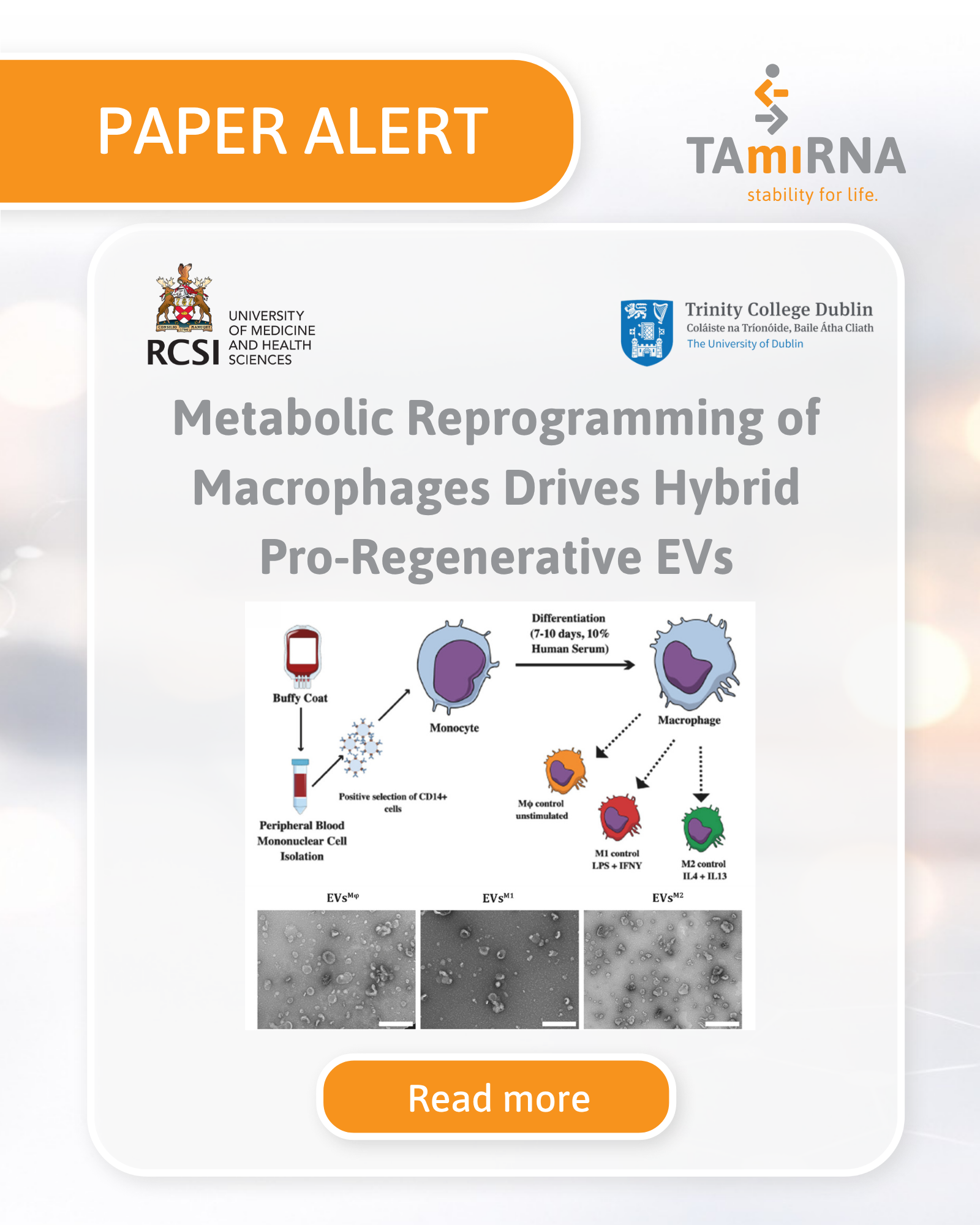
Huge congrats to Cansu Gorgun and the teams at Royal College of Surgeons in Ireland (RCSI) and Trinity College Dublin on their new publication in Biomaterials! This study is a fascinating look at how we can "train" macrophages to do two things at once. By reprogramming their metabolism, the team produced hybrid M1/M2 extracellular vesicles — a "dual-action" package that combines pro-inflammatory and pro-healing signals. We were lucky enough to support this work at 𝗧𝗔𝗺𝗶𝗥𝗡𝗔 by characterizing the EV miRNA cargo and looking into the functional implications of these hybrid vesicles. It’s a clever, elegant approach that opens new possibilities for smarter wound healing, tissue repair, and cell-free regenerative therapies. Fantastic work by everyone involved! TAmiRNA EV [...]

11 03, 2026

TAmiRNA @ RNA Leaders Europe Conference

2026-03-11T10:10:00+01:00March 11th, 2026|biomarker, circulating miRNAs, Conference, microRNA, microRNA services, NGS, RNA|Comments Off on TAmiRNA @ RNA Leaders Europe Conference

Vienna, Austria – 17.-19. March 2026 TAmiRNA is pleased to announce that CEO/CSO Matthias Hackl and Head of R&D Teresa Krammer will attend the upcoming RNA Leaders Europe Conference, one of the leading industry events dedicated to RNA therapeutics, innovation, and translational research. RNA Leaders Europe brings together key stakeholders from academia, biotech, pharma, and technology providers to discuss the latest scientific advances, regulatory developments, and commercialization strategies in the rapidly evolving RNA field. As a specialized provider of RNA-focused services, TAmiRNA supports partners worldwide with comprehensive solutions ranging from RNA profiling and biomarker discovery to advanced bioinformatics and customized data analysis. The conference offers an excellent platform to exchange insights, explore collaborations, and discuss how cutting-edge [...]

2 03, 2026

Independent Validation of Circulating microRNAs as Biomarkers in Type 1 Diabetes

2026-03-02T10:12:31+01:00March 2nd, 2026|biomarker, circulating miRNAs, Illumina NewSeq2000, microRNA, microRNA services, NGS, T1D, Type 1 Diabetes|Comments Off on Independent Validation of Circulating microRNAs as Biomarkers in Type 1 Diabetes

TAmiRNA is proud to contribute to a newly published peer-reviewed study demonstrating the independent validation of circulating microRNAs (miRNAs) as biomarkers in adolescents with long-standing type 1 diabetes (T1D). The study, published in PLOS ONE (2026), strengthens growing evidence that circulating microRNAs serve as minimally invasive biomarkers with potential applications in disease monitoring and precision medicine. Study Overview: microRNA Biomarkers in Adolescent Type 1 Diabetes Reliable biomarkers are essential for improving disease monitoring and long-term management of type 1 diabetes. MicroRNAs — small, non-coding RNA molecules regulating gene expression — are detectable in blood and have emerged as promising non-invasive diagnostic and prognostic tools. This case-control study investigated previously reported circulating miRNAs in: 24 adolescents with type [...]

21 01, 2026

New white paper with RoosterBio on omics-tools for EV characterization

2026-01-22T11:53:45+01:00January 21st, 2026|EV characterization, exosomes, extracellular vesicle, miND, miND spike-in, NGS, sequencing, small RNA-sequencing|Comments Off on New white paper with RoosterBio on omics-tools for EV characterization

In this white paper, TAmiRNA and RoosterBio present a comprehensive small RNA-sequencing–based characterization of mesenchymal stem cell (MSC)–derived exosomes produced using RoosterBio’s standardized, xeno-free manufacturing platform. The study was designed to assess both the analytical robustness of TAmiRNA’s miND® small RNA-sequencing workflow and the biological relevance of microRNA cargo profiling as an advanced “omics-based” characterization strategy for therapeutic extracellular vesicles (EVs). Using technical replicates and independent EV vials, we demonstrate that small RNA-sequencing performed with the miND® workflow yields highly reproducible and quantitatively consistent microRNA profiles, confirming the robustness of the analytical pipeline and the stability of RoosterBio’s EV products. In addition, comparative profiling of EVs derived from umbilical cord, bone marrow, and adipose tissue MSCs revealed [...]

7 01, 2026

TAmiRNA Research on microRNA Biomarkers for Periprosthetic Joint Infections Featured on Wien Heute, One of Austria’s Most-Watched Regional News Programs

2026-01-21T08:39:17+01:00January 7th, 2026|biomarker, Illumina NewSeq2000, microRNA, microRNA services, miND, miND spike ins, miND spike-in, NGS, Osteoarthritis, quality, Synovial fluid|Comments Off on TAmiRNA Research on microRNA Biomarkers for Periprosthetic Joint Infections Featured on Wien Heute, One of Austria’s Most-Watched Regional News Programs

Research conducted by TAmiRNA in collaboration with the Michael Ogon Laboratory (Orthopädisches Spital Speising) on microRNA-based biomarkers for the early detection of periprosthetic joint infections (PJI) was recently featured on Wien Heute, one of Austria’s most widely viewed regional television news programs (ORF, January 3, 2026). The coverage highlights both the clinical relevance of the problem and the translational potential of novel molecular diagnostic approaches. Periprosthetic joint infections are among the most serious complications following hip and knee arthroplasty. Although the incidence is estimated at approximately 1-10%, PJIs are associated with substantial morbidity, prolonged treatment, and high healthcare costs. A major challenge in clinical practice remains the timely and reliable differentiation between infected and non-infected implants, particularly [...]

4 12, 2025

Synovial Fluid and Serum microRNA Signatures in Equine Osteoarthritis

2025-12-04T11:05:09+01:00December 4th, 2025|biomarker, Illumina NewSeq2000, microRNA, microRNA services, miND, miND spike ins, miND spike-in, NGS, Osteoarthritis, quality, Synovial fluid|Comments Off on Synovial Fluid and Serum microRNA Signatures in Equine Osteoarthritis

New research highlights the potential of circulating miRNAs as biomarkers for joint degeneration A new peer-reviewed study has been published in the International Journal of Molecular Sciences (IJMS): “Synovial Fluid and Serum MicroRNA Signatures in Equine Osteoarthritis.” This work provides important insights into how microRNAs (miRNAs) in serum and synovial fluid reflect the presence of osteoarthritis (OA) in horses. 🎯 Study Aim The researchers sought to identify disease-associated miRNAs that differ between healthy horses and horses with osteoarthritis. Their goal was to uncover molecular signatures that could support the development of novel biomarkers for early detection and monitoring of OA. 🔬 Methods Serum and synovial fluid samples were collected from healthy controls (n = 4) and horses [...]

26 11, 2025

TAmiRNA and Orthopaedic Hospital Speising Publish Landmark Data on promiR® for Accurate Diagnosis of Periprosthetic Joint Infections

2025-12-04T11:05:55+01:00November 26th, 2025|biomarkers in orthopaedics, Illumina NewSeq2000, microRNA, microRNA services, miND, miND spike ins, miND spike-in, NGS, periprosthetic joint infections, promiR, quality, Synovial fluid|Comments Off on TAmiRNA and Orthopaedic Hospital Speising Publish Landmark Data on promiR® for Accurate Diagnosis of Periprosthetic Joint Infections

On November 19th, 2025, the study “Synovial Fluid MicroRNA Biomarkers Enable Accurate Diagnosis of Hip and Knee Periprosthetic Joint Infections” by Frank et al. was published in the Journal of Bone and Joint Surgery. This peer-reviewed publication marks an important milestone in TAmiRNA’s biomarker development program and presents promiR®, our novel microRNA-based diagnostic panel designed to improve the pre-operative assessment of periprosthetic joint infections (PJIs). Clinical Challenge PJIs remain one of the most serious and difficult complications following total joint replacement. Current diagnostic methods—including inflammatory markers, imaging, and cultures—often lack sensitivity and specificity, especially for low-grade or culture-negative infections. Even advanced approaches such as PCR or next-generation sequencing can suffer from contamination risks and ambiguous [...]

11 11, 2025

Distinct microRNA profiles in human amniotic membrane its vesicular and non-vesicular secretome revealed

2025-11-11T08:44:13+01:00November 11th, 2025|exosomes, extracellular vesicle, Illumina NewSeq2000, microRNA, microRNA services, miND, miND spike ins, miND spike-in, NGS, quality|Comments Off on Distinct microRNA profiles in human amniotic membrane its vesicular and non-vesicular secretome revealed

Vienna, Austria – November 2025 TAmiRNA scientist have contributed significantly to a new study published by the Ludwig Boltzmann Institute for Traumatology, which is titled “Distinct miRNA profiles in human amniotic tissue and its vesicular and non-vesicular secretome”. The article was published in Frontiers in Cell and Developmental Biology on October 29th 2025. Human amniotic membrane (hAM) has been used in tissue regeneration and wound healing applications. In this study, the miND® small RNA-sequencing workflow was applied to generate fresh insights into the microRNA composition of two spatially and physiologically distinct regions of the human amniotic membrane (hAM) and its secreted extracellular vesicles (EVs) and protein-bound miRNAs. The work highlights how advanced analytical workflows can uncover tissue- [...]

Go to Top